The Deaf Chef Who Made Plate Presentation an Art Form at a 5-Star Mumbai Hotel
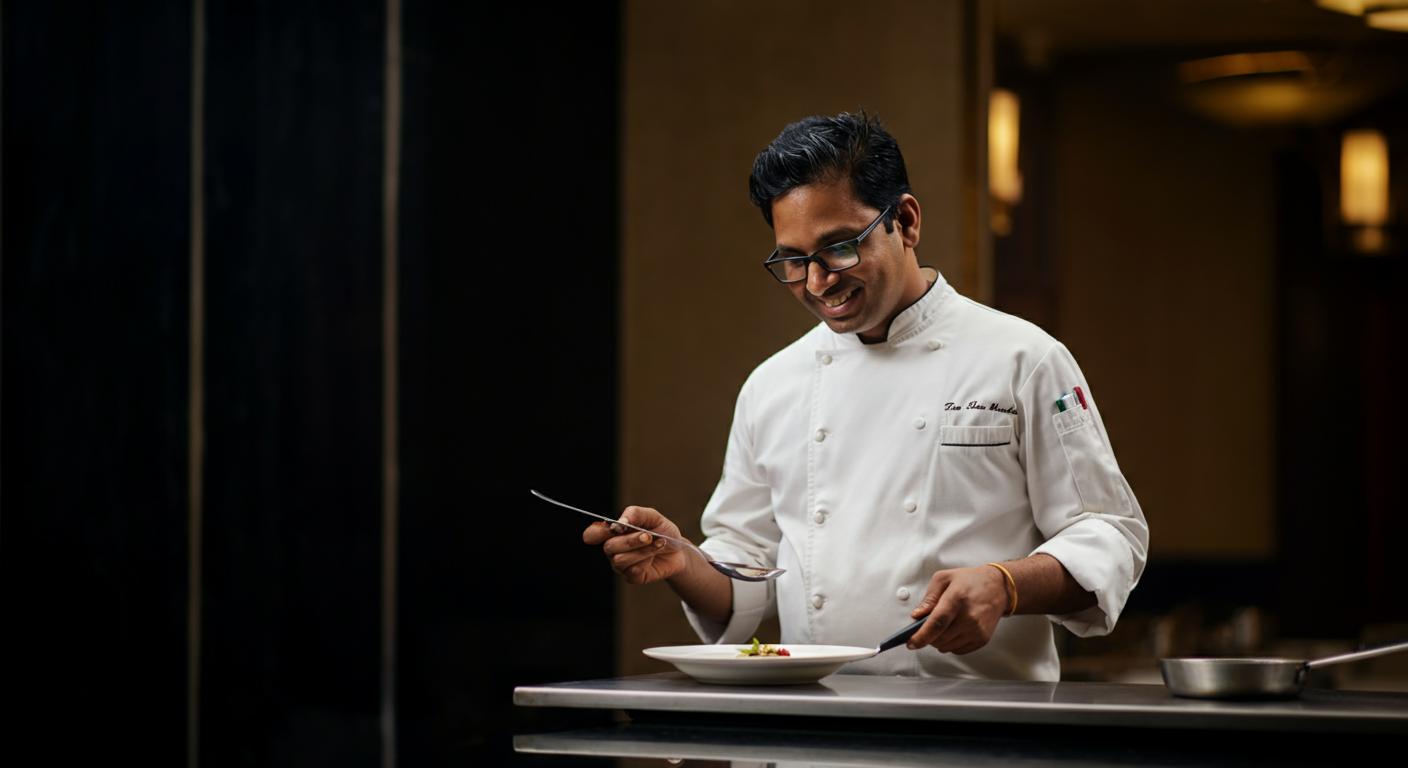
A professional kitchen runs on noise. The sizzle of a hot pan. The call-and-response of "oui, chef." The clatter of service, the shout of "behind!" as a cook moves through a crowded pass. For Preethi Nair, who has been profoundly deaf since age 4 following a childhood illness, none of this is available as a communication medium. What is available: her eyes, which perceive a plating station with the precision of a painter perceiving a canvas; her hands, which produce dishes that the executive chef at a 5-star hotel in Mumbai's BKC district describes as "the most consistently beautiful plates on our kitchen line." The deaf chef career hospitality India story that Preethi has built is a story about reimagining kitchen communication — and discovering, in the process, that the reimagining produces a better kitchen for everyone.
Preethi, 30, is a Demi Chef de Partie at a 5-star international hotel chain's flagship Mumbai property. She specialises in cold kitchen (garde manger) and dessert plating — the stations where visual precision is most valued and where her particular gifts produce the most visible results. She earns ₹38,000 per month (plus service charge and benefits), has twice won the hotel's internal "Dish of the Month" presentation award, and is being mentored for promotion to Chef de Partie within the next 18 months.
The Visual Communication System Preethi Built for Her Kitchen
When Preethi joined the hotel's kitchen team as a Commis Chef three years ago, she sat down with her executive chef and her section head on her first week and designed a kitchen communication protocol together. This is the most important thing she did — not as an accommodation request, but as a professional onboarding action. "I needed my team to know how to work with me safely and effectively. I asked for a planning meeting. We made a plan. That is what professionals do."
The visual signal system
Preethi and her team use 12 hand signals — a small vocabulary they developed together over two weeks, based on the most frequent kitchen communications: "behind you," "fire," "table ready," "come here," "good," "re-plate," "wait," "expedite," "break," "chef is coming," "all good," and "service." Every member of her section knows these signals. They were laminated and posted at the entrance to the section during the first month; most team members memorised them within two weeks.
Vibration alerts for timers
Preethi uses a wristwatch with vibration alerts for cooking timers. Multiple timers can be set with different vibration patterns (2 short pulses = oven, 3 short = stovetop reduction, 1 long = cold station holding time). She has never missed a timer. Her section head notes that her mise en place — the preparation and organisation of ingredients before service — is the most meticulous on the line, in part because she relies on visual and tactile organisation rather than auditory reminders.
The "tap-on-shoulder" protocol
For urgent communications, any team member can tap Preethi on the shoulder (once for attention, twice for urgent). This is communicated to all new kitchen staff as standard section protocol during their first week. The clarity of this protocol means Preethi is never surprised and team members are never uncertain about how to reach her.
Visual fire and safety alerts
The hotel installed vibrating floor pads at Preethi's primary station and at the cold kitchen entrance that activate with the kitchen's alarm system — an accommodation that cost approximately ₹12,000 and was covered by the hotel's accessibility budget. This ensures fire and emergency alerts reach her regardless of ambient sound level.
The plating data
The hotel's F&B director commissioned an informal internal study after Preethi won her second Dish of the Month award: how did guest social media posts of plated dishes from her station compare to posts of dishes from other stations? The result: dishes from Preethi's plating shifts received 3.4× more Instagram engagement per post than equivalent dishes from other shifts. The hotel now specifically schedules her on high-profile tasting menu service dates. Plate aesthetics have measurable commercial value in luxury hospitality, and Preethi's visual intelligence is a directly measurable business asset.
Why Her Deafness Produces Better Plates
Preethi has a theory about why her plating is consistently the most precise on her line, and her section head agrees with it. In a kitchen, every cook is managing multiple sensory inputs simultaneously: the sound of sizzling telling them a temperature is right, the smell of caramelisation, the visual state of the plate, the voice of the expediter. Most of these inputs compete for attention, and the cook divides their focus accordingly.
Preethi receives none of the auditory inputs. She is not distracted by the expediter's voice, the background kitchen noise, the adjacent station's radio. When she is plating, she is entirely focused on the plate. Her visual attention to the plate is undivided. The result is visible in every dish she touches.
"When I plate, I see nothing but the plate," she explains through her section head, who interprets for her during interviews. "Every element has a position. Every sauce has a shape. Every garnish has a reason. I do not compromise any of these because someone is shouting near me. I do not hear the shouting."
The Culinary School Path and Getting the First Kitchen Job
Preethi attended the Institute of Hotel Management in Mumbai, where she disclosed her deafness during the application process. The institute accommodated her through a designated front-row seat in all theory classes, written exam formats for all oral assessments, and a communication buddy system for kitchen practicals — a fellow student who shadowed her during commercial kitchen training to ensure she received all communications in real time.
Her first industry job was at a city cafe, where the owner — having reviewed her IHM portfolio and practical grades (she graduated in the top 10% of her batch) — was willing to run a two-week trial before formal hire. By day three of the trial, the cafe owner had personally learned the 12 signal vocabulary and was using it to communicate with Preethi on the floor. "She told me later she learned it because it was faster than writing on a notepad. That is true. Our communication is genuinely efficient."
For Deaf Professionals in Culinary and Hospitality
- Design your kitchen communication system before your first day. Don't wait to see if hearing colleagues figure it out. Arrive on Day 1 with a proposed signal vocabulary, a written protocol for safety communications, and a clear explanation of your vibration timer system. This positions you as organised and safety-conscious — the exact qualities a chef values in a kitchen team member.
- Target cold kitchen, pastry, and garde manger stations first. These stations value visual precision most explicitly and operate at a slightly lower verbal intensity than hot sections. They are excellent entry points for a deaf cook to demonstrate capability before expanding to hotter and louder stations.
- Ensure safety protocol accommodation is in writing. Fire and emergency alert accommodation (vibrating floor pads or pager systems) must be confirmed in writing before your first shift. This is a legal requirement under the RPWD Act 2016 and a non-negotiable safety matter — not a preference.
- Find hospitality employers with genuine inclusion records through IMAbled's job board. Several 5-star hotel groups, restaurant chains, and catering companies in Mumbai, Delhi, and Bengaluru have documented inclusion programmes and experience accommodating deaf kitchen staff.
"The guest does not hear the kitchen when they receive the plate. They see it. I see it the same way they will. That is my advantage." — Preethi Nair, Demi Chef de Partie, Mumbai
Frequently Asked Questions
Can a deaf person safely work in a professional kitchen in India?
Yes — with appropriate visual and vibration-based safety communication systems in place, deaf chefs work safely in professional kitchens worldwide and in India. The key safety elements are: vibration-based fire and emergency alerts, a clear hand-signal vocabulary for team communication, and a tap-on-shoulder protocol for urgent communications. These are simple, low-cost systems that any professionally run kitchen can implement. Under the RPWD Act 2016, employers are required to provide safety accommodations for specially-abled employees.
What culinary schools in India accommodate deaf students?
Several IHM (Institute of Hotel Management) campuses in Mumbai, Delhi, and Chennai have experience accommodating deaf students. The National Council of Hotel Management (NCHM) joint entrance examination provides accommodation for specially-abled candidates. Private culinary schools including the Culinary Institute of India and Lavonne Academy of Baking Science (Bengaluru) have accommodated deaf students in recent years. Contact institutions directly to confirm current provisions.
Which kitchen stations are most accessible for deaf chefs?
Cold kitchen (garde manger), pastry, and dessert plating stations are the most accessible starting points — they operate at lower verbal intensity than hot sections and value visual precision most explicitly. Hot kitchen stations (grill, sauté, sauce) are fully accessible with appropriate communication systems in place, and many deaf chefs work these stations professionally after establishing their communication protocol with a team that knows them well.
What vibration alert systems are available for deaf kitchen workers in India?
Smartwatches with vibration timer functionality (Apple Watch, Samsung Galaxy Watch, and several Android watches) serve as cooking timer systems. Vibrating floor pads or pager systems connected to the kitchen's fire alarm can be installed for emergency alerts — these are available through assistive technology suppliers in Mumbai, Delhi, and Bengaluru, and typically cost ₹8,000–20,000 for a kitchen setup. The ADIP scheme can fund assistive technology for workplace use.
How should a deaf person approach job applications in hospitality?
Lead with your culinary portfolio — grades, practical assessments, and any competition results. Request a trial or practical assessment rather than (or in addition to) a standard interview — your ability in the kitchen is more relevant than verbal interview performance. In the trial, arrive with your communication system pre-prepared (signal vocabulary card, timer setup, protocol explanation). This demonstrates the organisational competence that professional kitchens value above everything else. Find inclusive hospitality employers on IMAbled's job board.