Typing With Toes: India's First Specially-Abled Court Reporter
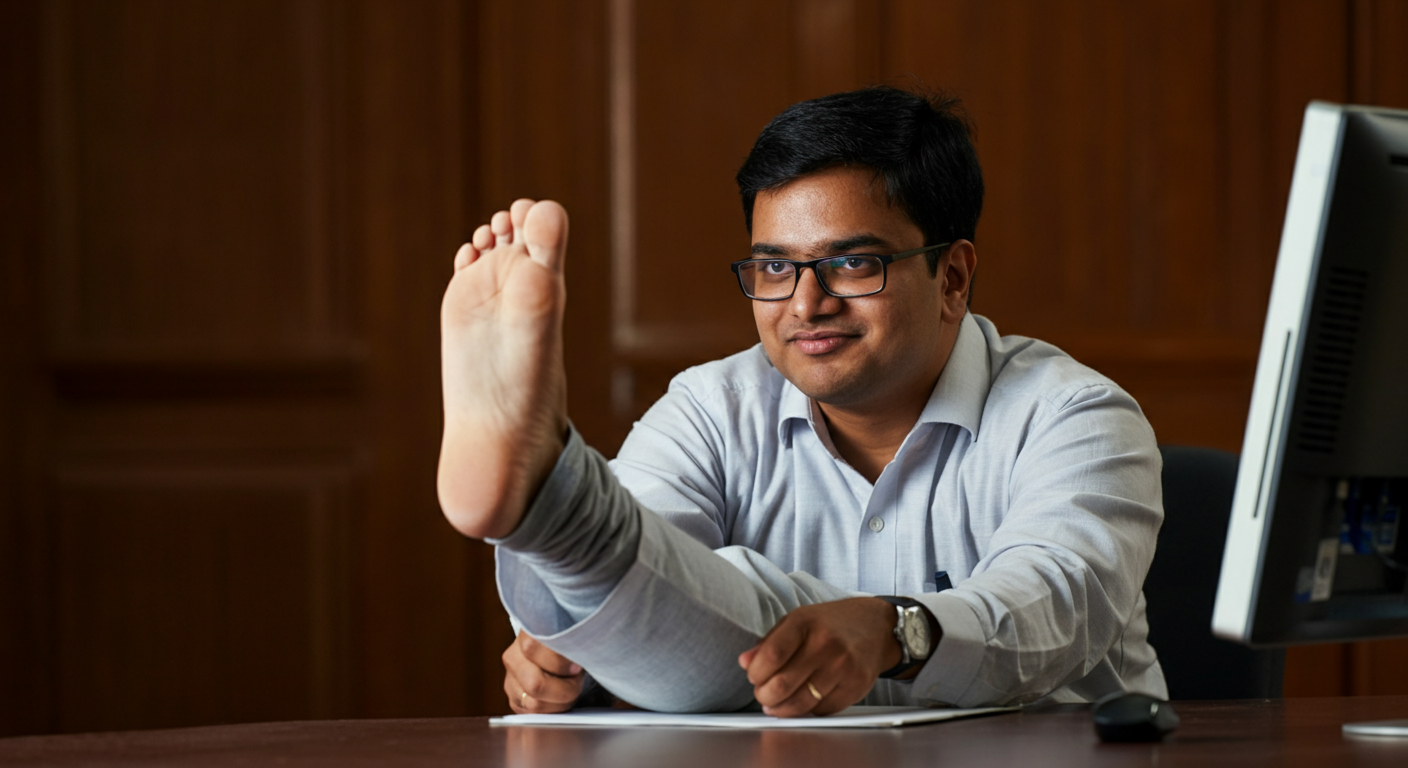
Kavya Menon types at 80 words per minute. She types on a modified stenotype machine. She types with her feet. Born without functional use of both arms due to a congenital condition affecting her upper limbs, Kavya spent her childhood learning to navigate a world built for hands — and her professional life building a career in the one field that most visibly demands them. The story of this limb difference court reporter career India is, in every technical and human sense, extraordinary. But Kavya refuses the word. "I am a court reporter," she says, with characteristic precision. "My feet type. This is the most interesting thing about my working method, but it is not the most important thing about my work."
Kavya, 31, is a certified court reporter and legal transcriptionist based in Kochi, currently working across three Circuit Courts and providing freelance transcription services to two law firms. She is the only foot-based stenographer in India to have passed the All India Shorthand Writers' Examination and received court reporter certification from the Bar Council of Kerala. She earns ₹7.8 lakh per annum from her combined court and freelance work — higher than the Indian court reporter median of approximately ₹4.5–5.5 lakh.
How Kavya Types — The Technical Reality
Kavya's adaptation was not invented for her — she invented it herself, over six years of experimentation beginning at age 18. The core system:
Modified stenotype machine
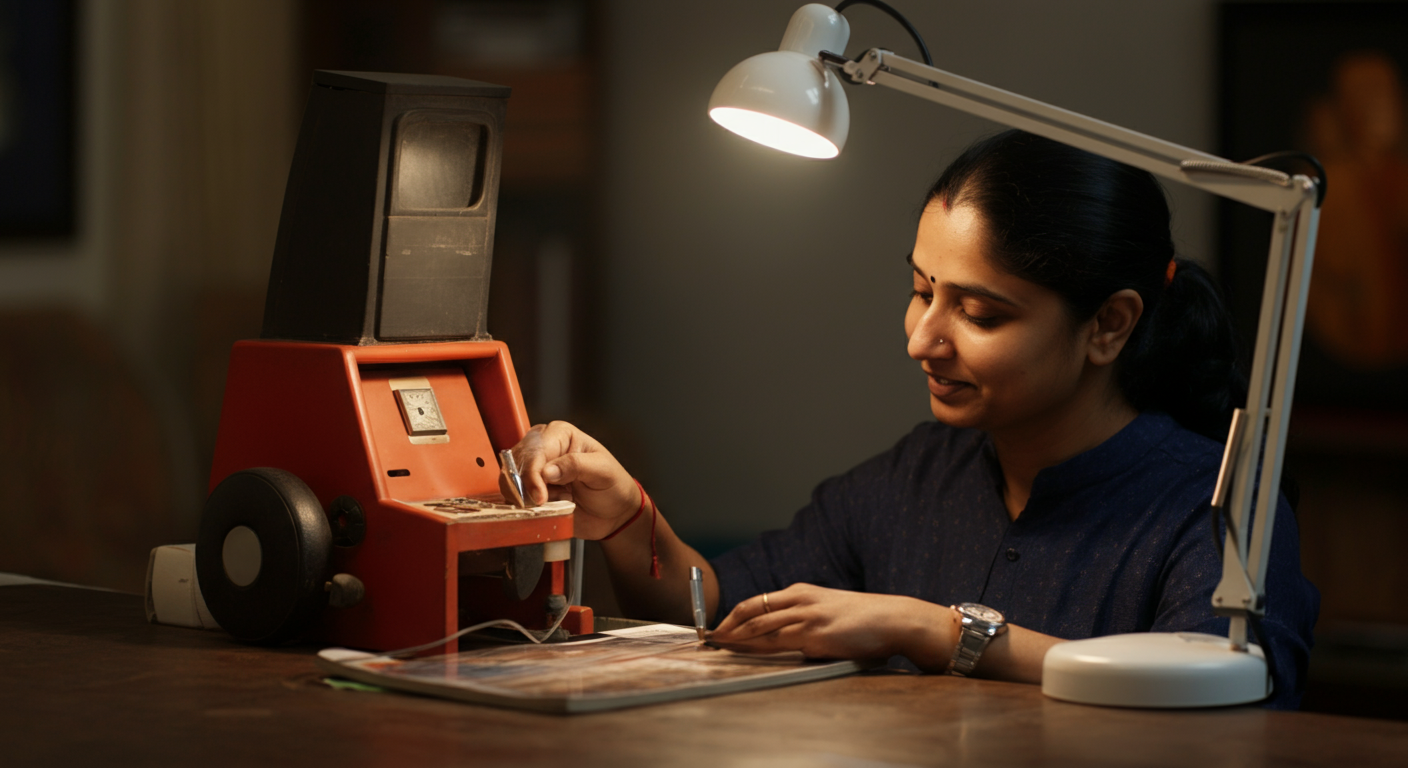
Standard stenotype machines are designed for hand operation. Kavya worked with a local engineer in Kochi to build a floor-mounted version of a stenotype key layout, with wider, softer keys spaced for toe operation. The machine interface connects to the same CAT (Computer-Aided Transcription) software used by all professional court reporters — the modification is entirely in the input hardware. The output — formatted transcript text — is identical to any other court reporter's output. The process by which it is produced is simply different in its mechanics.
Typing speed development
At 18, Kavya's foot-typing speed was 12 words per minute — roughly the same speed at which many children with no typing training begin. Six years of daily practice brought her to 80 words per minute — above the 60 WPM minimum required for court reporter certification, and sufficient for real-time courtroom transcription at standard speech rates. "The feet are less precise than fingers but not less capable. They simply need more training. No one told me this was impossible, because no one had tried."
Workstation setup
Kavya's court workstation is a low, angled platform at foot level with her machine, a monitor at eye height (she operates the display with a head-mounted pointer for mouse functions and voice control for non-typing operations), and a chair adjusted so her feet rest comfortably on the typing surface. Setup time in a new courtroom: approximately 12 minutes. Every court she works with has accommodated this setup without incident.
The motor learning research that explains Kavya's achievement
Neuroscience research on alternative limb function has consistently demonstrated that the human motor cortex is substantially plastic — it can assign precision motor control to any body part with sufficient training. Studies of foot typists (a small population globally, primarily individuals with upper limb differences) document foot typing speeds of 60–120 WPM after adequate training, comparable to average hand typing speeds. Kavya's 80 WPM is within the documented range of human foot typing capability — remarkable, but not neurologically impossible.
The Path to Certification — and the Barriers That Were Mostly Bureaucratic
Kavya's path to court reporter certification was complicated by exactly one thing: no one at the examining authority had previously considered whether foot-based stenography should be classified as equivalent to hand-based stenography. The answer, once the question was posed formally with a live demonstration and a technical explanation, was an obvious yes. The transcript produced is identical. The accuracy is identical. The certification criteria — speed and accuracy thresholds — are met. The method of input is different.
The Bar Council of Kerala's certifying committee met three times over four months to assess her application. She passed their practical test with 98.4% accuracy at 78 WPM — above the minimum threshold and higher than several simultaneously-assessed hand typists. She was certified. The precedent is now set in Kerala, and her case has been submitted to the Bar Council of India as a model for national standardisation of adaptive input assessment.
Her Work in the Courtroom
Kavya describes courtroom transcription as "the most demanding and most rewarding listening exercise I know." Judges, lawyers, and witnesses speak at varying speeds, with varying accents, through varying levels of emotional intensity. The court reporter's job is to capture every word, exactly as spoken, in real time, with no second chances. For Kavya, who cannot raise her hand to ask for a speaker to slow down, she has developed a set of professional protocols for managing speech rate: a small LED signal on the judge's bench that she can activate with a voice command when transcription speed is being exceeded, and a post-session protocol for confirming unclear segments with the presiding judge.
Judges and lawyers who have worked with Kavya describe her transcripts as among the most accurate they have seen. Her accuracy rate on the last independent audit of her transcripts: 99.1%. For reference, the profession standard is 95% minimum.
What This Means for Legal Careers and Limb-Different Professionals
Kavya's case is important beyond her own career because it establishes that the barrier to legal transcription and court reporting for upper-limb-different professionals is not capability — it is precedent. Once the precedent exists (as it now does in Kerala), the pathway is technically and legally clear for others to follow.
Beyond court reporting, the legal profession has multiple roles where limb differences are navigated through adaptive input technology: legal transcriptionist, legal research assistant, contract drafter, compliance analyst, and legal content writer are all roles where voice typing, foot typing, head-mounted pointer systems, and eye-tracking technology enable full professional participation.
For professionals with upper limb differences exploring legal careers, connect with IMAbled's job board for verified inclusive employers in the legal sector, and with NGO partners who support adaptive technology access and professional placement.
For Professionals With Limb Differences: Your Roadmap in Legal Careers
- Identify your adaptive input method early and practise intensively. Whether foot typing, voice-to-text, head pointer, or eye-tracking, your speed and accuracy in your chosen input method is your primary professional credential. Build it systematically.
- Seek certification through the standard process with adaptive demonstration. Kavya's precedent shows that examining bodies will assess adaptive methods on output quality, not input mechanism, if the request is made formally and clearly with documentation.
- Document your accuracy and speed data. In any profession where your input method differs from convention, output quality data — accuracy percentages, speed benchmarks, audited samples — is your most effective response to any scepticism about your capability.
- Connect with adaptive technology organisations. The IMAbled NGO partner network includes organisations with expertise in adaptive technology access and employment support for professionals with limb differences.
"The court does not care how the transcript is produced. It cares whether every word is accurate. I am exceptionally accurate. Everything else is engineering." — Kavya Menon, Certified Court Reporter, Kochi
Frequently Asked Questions
Can someone without upper limb function become a court reporter in India?
Yes — Kavya Menon's certification in Kerala establishes this precedent. The certification criteria (speed and accuracy thresholds) assess output quality, not input method. Foot typing, voice transcription with post-session editing, and other adaptive input methods can produce court-reporter-quality transcripts. The RPWD Act 2016 requires reasonable accommodation in professional certification processes.
What typing speed is required for court reporter certification in India?
The All India Shorthand Writers' Examination requires 60 WPM in shorthand and a minimum accuracy threshold for transcription. State Bar Council requirements vary slightly. Kavya passed at 78 WPM with 98.4% accuracy. Foot typing speeds of 60+ WPM are achievable with sustained practice — the neuroscience of motor learning supports this, and existing foot typists globally document speeds in this range.
What legal support roles suit professionals with upper limb differences?
Legal research analyst (primarily reading, analysis, and voice-drafted writing), contract reviewer and drafter (voice typing and text-to-speech tools), compliance analyst, legal content writer, paralegal (document review and management), court reporter (with adaptive input), and legal transcriptionist are all accessible roles. Voice-to-text technology has significantly expanded the range of legal roles accessible to professionals with upper limb differences.
What assistive technology is available for professionals with upper limb differences in India?
Voice typing (Google Docs, Dragon NaturallySpeaking), head-mounted pointer systems, eye-tracking software (Tobii Dynavox), foot mice, foot keyboard adaptations, and mouth/chin sticks for standard keyboards are all available in India. Government schemes including ADIP (Assistance to Disabled Persons) and NHFDC loans support assistive technology procurement. NGO partners in the IMAbled network can advise on access to these schemes.
How can a professional with a limb difference approach the legal profession's certification process?
Request accommodation from the certifying authority in writing, citing the RPWD Act 2016's requirement for reasonable accommodation in all professional examinations and certifications. Provide a formal written description of your adaptive input method, a demonstration of your speed and accuracy using that method, and examples of your output quality. Most certifying bodies, once the request is formulated this clearly, will assess output quality rather than input mechanism. Document every communication in writing.