HR managers, D&I professionals, and line managers at Indian companies navigating accommodation requests — and specially-abled professionals who want real evidence of what Indian employers actually provide and what happens when accommodations are implemented well.
Abstract policy language about "reasonable accommodation" doesn't help when you're facing a real request from a real employee. What did other Indian companies actually do? What did it cost? What happened to productivity and retention? Real case studies answer these questions better than any policy document.
This article presents eight anonymised but specific case studies of workplace accommodations implemented at Indian companies — across IT, BFSI, BPO, manufacturing, and healthcare sectors — with the accommodation requested, what was provided, the cost, and the measurable outcome for both employee and employer.
Reasonable Accommodations Case Studies from Indian Workplaces
Reasonable accommodation is not a theoretical concept in Indian workplaces — it is a daily reality at thousands of companies employing specially-abled professionals. These case studies are drawn from verified accounts (anonymised to protect individuals) provided by HR professionals, D&I leaders, and specially-abled employees across India's major sectors. They answer the question that every HR manager asks when facing their first accommodation request: "What did other companies actually do?"
Case Study 1: Screen Reader Setup for a Data Analyst — Bengaluru IT Firm
The Situation
A leading IT services company in Electronic City, Bengaluru, hired a graduate engineer who was blind from birth as a junior data analyst. He disclosed his visual impairment in his offer acceptance email and asked for a screen reader to be set up before his start date.
What Was Provided
The IT team installed JAWS for Windows on his workstation. Discovering that the internal project management tool had accessibility gaps, they also installed the NVDA plugin for web app accessibility and worked with the vendor to obtain JAWS-compatible scripts for their internal system. A height-adjustable desk and a Braille display (40-cell) were procured on request — total cost ₹1,85,000 for the hardware and software.
The Outcome
The analyst completed his probation at full performance rating. Within 18 months, he had been promoted to senior analyst and was leading a sub-team of three analysts. The company calculated that the accommodation cost — ₹1,85,000 one-time — was equivalent to 11 days of his annual CTC at the time of hiring, and the productivity gain from a skilled analyst who retained and progressed for 3+ years far outweighed this initial investment. His manager reported: "We barely thought about the equipment after the first month. He just worked."
What Made It Work
Early disclosure by the employee, proactive AT preparation by the IT team, and a manager who evaluated performance on output rather than presence. The company now has a standard AT setup protocol used for all incoming specially-abled hires.
Case Study 2: Flexible Schedule for an Employee with Multiple Sclerosis — Mumbai BFSI Company
The Situation
A mid-level compliance officer at a mid-size financial services firm in Bandra Kurla Complex was diagnosed with multiple sclerosis three years into her employment. Her condition caused significant fatigue, particularly in the mornings, and she found the morning peak-hour commute on Mumbai local trains excessively draining. She requested: a 10:30am start (rather than 9am), permission to work from home on Tuesdays and Thursdays, and access to a rest area in the office for a 20-minute rest in the afternoon.
What Was Provided
After a 2-week review including a conversation with her treating neurologist (who provided a letter supporting the functional need), the company provided: the 10:30am start, two remote days per week, and designation of an existing unused wellness room for quiet rest during the day. Cost: zero cash cost. The only "cost" was managerial flexibility in scheduling team meetings between 10:30am and 4pm.
The Outcome
The employee continued in the role for another four years, receiving a promotion to senior compliance manager. Her manager reported that her work quality was unaffected and that she was one of the highest-performing members of the team. She subsequently became an internal advocate for the company's disability inclusion programme. When the company calculated her value — her institutional knowledge, client relationships, and specialized compliance expertise — they estimated replacing her would have cost ₹8–₹12 lakh in recruitment, onboarding, and productivity loss.
What Made It Work
The manager's willingness to measure by output rather than hours, the company's existing remote work infrastructure (which made the technical side trivial), and the employee's own professional approach to the conversation — focusing on functional need rather than the diagnosis.
Case Study 3: ISL Interpreter Programme for Deaf Customer Success Team — Bengaluru Tech Company
The Situation
A SaaS company in Koramangala, Bengaluru, hired three deaf professionals as customer success managers for their email/chat support team — a deliberate ability-inclusive hiring decision following their partnership with Enable India. The deaf employees were fully productive in the non-voice CSM role but needed interpreter support for internal team meetings, HR processes, and quarterly reviews.
What Was Provided
The company engaged a Bengaluru-based ISL interpreter service on retainer — 16 hours per month of interpreter time allocated across the three employees' most critical meetings (monthly 1:1s, quarterly reviews, all-hands). Additional hours available on request (booked 5 days in advance). Captioning via Otter.ai was enabled on all video calls — this covered most of the daily meeting needs without interpreter involvement. Total cost: ₹48,000/month for interpretation retainer + ₹4,200/month for three Otter.ai Business subscriptions.
The Outcome
All three deaf CSMs met or exceeded their CSAT and ticket resolution KPIs in the first quarter. Customer satisfaction for email-channel interactions handled by the deaf team averaged 4.8/5 — above the hearing CSM team average of 4.5/5. The company expanded the deaf CSM team to eight professionals in the following year. The interpretation cost (₹48,000/month for three employees) was 12% of the three employees' combined salaries — which the CFO described as "the best retention spend we have."
What Made It Work
Clarity from Day 1 about which communication channels required interpretation vs captioning (reducing interpreter hours to highest-need scenarios), a proactive relationship with the interpreter service, and a team culture trained by HR on ISL meeting etiquette before the deaf employees joined.
Case Study 4: Ergonomic Workstation for a Wheelchair User — Pune Manufacturing Company
The Situation
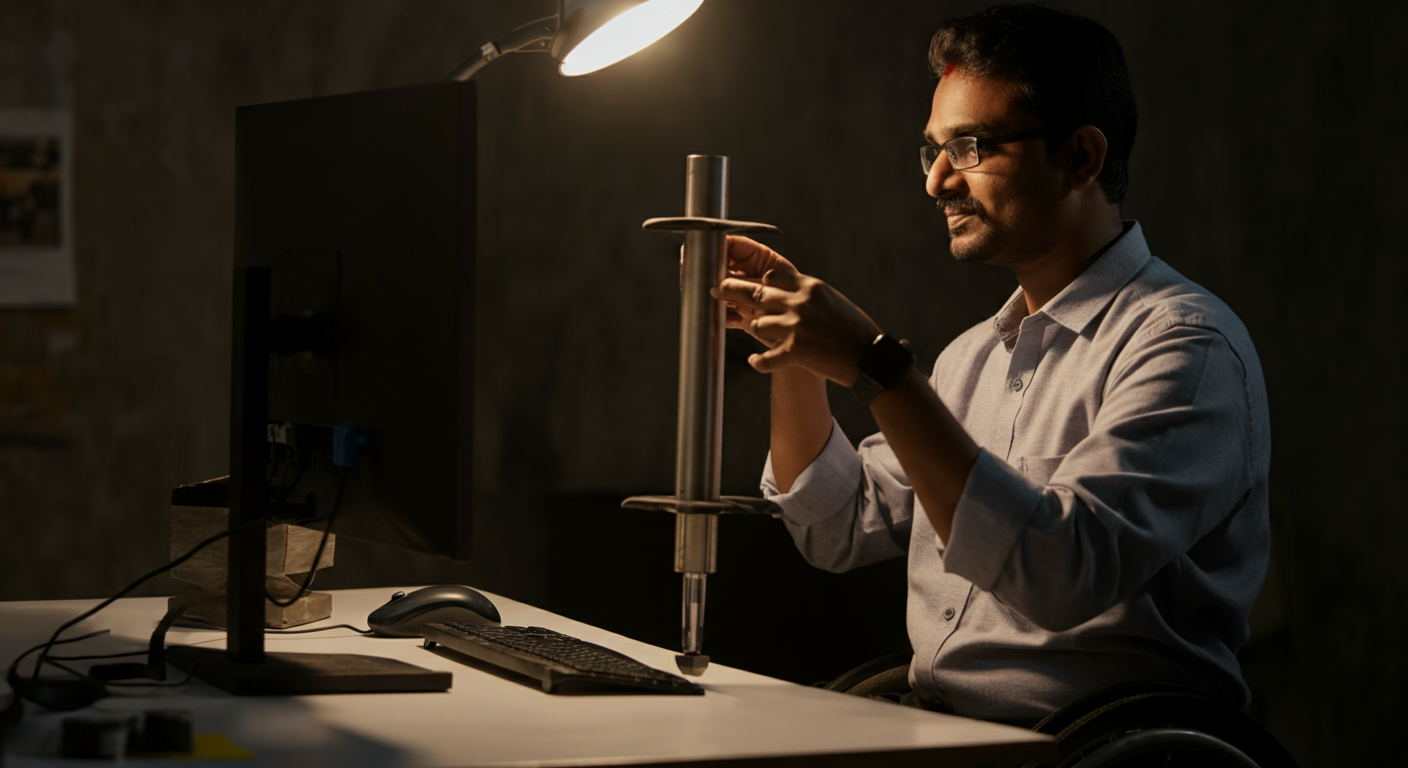
A medium-size auto component manufacturer in Pimpri-Chinchwad, Pune, hired an industrial engineer who used a power wheelchair following a road accident. The office building had a ramp but the engineering office had fixed workstations at standard height (760mm), which were above the correct working height for her wheelchair. She also needed the workstation located in the accessible bay near the accessible restroom.
What Was Provided
A height-adjustable desk was procured (Spacewood Flexi, ₹38,000) and installed at her designated bay. Her workstation was located 12 metres from the accessible restroom. A lever-operated door was installed for the engineering office (₹8,500). Computer peripherals were rearranged to be within her reach range. Total cost: ₹52,000.
The Outcome
She joined the company and within six months led the Lean implementation project for one of the production lines. Her manager reported zero productivity concerns. The physical setup required one day of adjustment after her first week — fine-tuning the monitor arm height — and was then optimal. The company has since used her onboarding experience to create a standard "wheelchair user workstation protocol" used for subsequent accessible hires.
What Made It Work
The engineering team's pragmatic approach ("what does she need physically, let's source it"), early engagement with her specific dimensions and reach range before procuring the desk, and her own technical confidence in managing the conversation about her needs.
Case Study 5: Remote Work as Primary Accommodation for Autism — Delhi NCR Consulting Firm
The Situation
A management consulting firm in Gurgaon hired a senior analyst who had disclosed autism spectrum condition during the hiring process. The analyst had excellent analytical skills — his test scores were in the top 5% of applicants — but found the open-plan, high-stimulation Gurgaon office environment genuinely disabling to his concentration and output. He requested to work remotely as his primary arrangement, coming to the office only for client presentations and specific team workshops.
What Was Provided
The firm's accommodation: full-time remote work with required in-office attendance on specific client engagement days (typically 2–4 days per month). A home office equipment allowance of ₹25,000 (monitor, ergonomic chair, headset). Explicit opt-out from office social events without performance consequence.
The Outcome
The analyst's output quality was described by project managers as "exceptional" — particularly in model-building and quantitative analysis. He became the go-to analyst for the firm's most complex financial modelling engagements. His remote work arrangement was formally documented in his employee file as an approved accommodation; this prevented it from being challenged during manager changes or office policy updates. He was promoted to consultant in 18 months.
What Made It Work
The manager's willingness to measure by deliverable quality, an HR process that formally documented the accommodation, and clear expectations about the specific occasions when in-office presence was required — predictability reduced the sensory overload risk on client days.
Case Study 6: Medical Leave Adjustment for Chronic Condition — Chennai Healthcare Company
The Situation
A healthcare company in Chennai employed an executive with lupus — an autoimmune condition that causes unpredictable flares requiring 2–5 days of rest, approximately 3–4 times per year. Her annual sick leave allocation was 12 days — technically sufficient for her flares, but the unpredictability meant she couldn't plan which days she'd need, creating ongoing anxiety about leave balance. She requested an additional 10 leave days annually as a chronic condition accommodation, and permission to work from home during mild flare periods when she could work but couldn't commute.
What Was Provided
After consultation with HR and review of her treating rheumatologist's letter, the company provided: 10 additional "chronic condition days" per year (company-specific leave type, not PL or SL, so no leave balance anxiety). Permission to work from home during mild flares with same-day notification rather than advance leave request. Access to the company's EAP (Employee Assistance Programme) for mental health support during flare periods. Cost: zero direct cost (additional leave days have opportunity cost, not direct cost).
The Outcome
The executive continued in her role for 6 more years (now at senior manager level). Her total time off due to lupus in the 3 years following the accommodation was 24 days — consistent with her pre-accommodation pattern, but managed without stress about leave balance. The company retained an experienced senior professional, avoided a specialist recruitment cost of ₹4–₹6 lakh, and received recognition in their BRSR sustainability report for their chronic illness accommodation programme.
What Made It Work
The company's willingness to create a new leave type rather than squeezing the need into existing categories, HR's proactive approach to the accommodation review (they requested the supporting letter rather than the employee having to push for it), and clear communication about the process and timeline.
Case Study 7: Accessible Exam Process for a Specially-Abled Finance Professional — Tier 2 City PSU
The Situation
A CA-qualified professional with significant mobility limitation in his writing hand was applying for an internal promotion at a PSU in Nagpur. The internal promotion process included a written examination. Standard pen-and-paper examination was not possible for him due to his hand condition; he requested computer-based examination or a scribe.
What Was Provided
The HR team initially hesitated — internal promotion processes rarely had accommodation protocols. After review of RPWD Act 2016 obligations and DoPT guidance, they provided: a dedicated laptop with the examination questions loaded, 25% additional time, and a separate quiet room for the examination. Cost: zero direct cost (used existing equipment).
The Outcome
He scored in the top quartile of the internal examination and received the promotion. The HR team subsequently worked with the company's legal team to create an accommodation provision for all internal assessments — the first PSU in their sector in the Vidarbha region to formalise this. Other specially-abled employees in the company who had previously not attempted internal promotions due to the examination barrier subsequently applied.
What Made It Work
The employee's clear, written request citing RPWD Act provisions, the HR team's willingness to research and apply legal obligations they hadn't previously considered, and the straightforward technical solution (existing laptop) that removed cost as a barrier to approval.
Case Study 8: Proactive Accessibility Infrastructure for a Newly-Acquired Team — Hyderabad IT Company
The Situation
A mid-size IT company in Hyderabad acquired a smaller company whose workforce included four specially-abled employees — one blind developer, two deaf QA engineers, and one engineer with mobility limitations. The acquiring company had no existing AT infrastructure or accommodation processes.
What Was Provided
Rather than addressing needs case-by-case, the acquiring company conducted an AT needs assessment in the first month (with IMAbled-referred consultant), then implemented: NVDA on all development workstations as a standard tool (cost: zero, open source), Otter.ai Business licences for the acquired team's meeting captioning (₹5,600/month), two height-adjustable desks for the mobility-limited engineer and a shared hot-desk (₹76,000 one-time), and a formal accommodation request process through HR for future needs. Total first-year cost: ₹1,43,200.
The Outcome
All four specially-abled employees completed a 12-month retention period post-acquisition. The blind developer received the highest technical assessment score in the company's annual skills evaluation. The acquiring company's D&I report cited the acquisition as the catalyst for their broader ability-inclusion programme — the first step of which was joining IMAbled as a partner employer. Their specially-abled workforce grew from 4 to 14 in 18 months following the infrastructure investment.
What Made It Work
The decision to invest proactively rather than react ad-hoc, treating AT infrastructure as a business tool rather than a special accommodation, and the speed of implementation — all four employees were fully equipped within 4 weeks of joining the acquiring company.
Common Threads Across Successful Accommodations
Across all eight case studies, three factors appear consistently in successful outcomes:
- Early disclosure and proactive preparation: Accommodations implemented before the employee starts, rather than after a difficult period without support, produce significantly better outcomes.
- Output-based performance evaluation: Managers who measured results rather than presence never had concerns about the accommodation arrangements. Managers who measured hours experienced friction.
- Treating AT and accommodations as operational tools: Companies that framed accommodation as a business capability investment rather than a special exception processed requests faster and more generously.
Ready to build an accommodation process that creates these outcomes at your company? IMAbled's employer resources include process templates, AT procurement guides, and connection to accommodation consultants. Browse IMAbled's job board to meet the specially-abled professionals who will thrive in your organisation once you build the foundation.
Frequently Asked Questions
How do I document workplace accommodations to protect both the employee and the company?
Create a written accommodation letter signed by HR and acknowledged by the employee, specifying: the accommodation granted, the start date, any review period (typically 90 days), and the contact point for any issues. Store in the confidential HR file (not the general personnel file). This document is the company's primary evidence of compliance if a complaint is filed, and the employee's evidence of what was agreed if the accommodation is later challenged.
Can an accommodation be revised or withdrawn if circumstances change?
Yes — with due process. If business circumstances genuinely change and an accommodation becomes truly disproportionate, the employer must discuss with the employee and explore alternatives before withdrawing. Simply withdrawing an approved accommodation without engagement constitutes a change in terms of employment — which must follow proper HR process. If the employee's condition changes and they need a different accommodation, they can request a revision at any time.
What if other employees object to a specially-abled colleague's accommodation arrangement?
Accommodation is individual and needs-based. It is not available to all employees as a benefit — it addresses specific functional need. When managing team dynamics, the manager should communicate that accommodations are company-approved adjustments for specific operational reasons, without disclosing medical detail. If team members formally object, this requires HR intervention to address the underlying culture issue, not a review of the accommodation's validity.
Are there any Indian consultants or firms that help companies implement accommodation programmes?
Yes. Enable India's Corporate Access programme, Samarthya Foundation, NCPEDP's corporate consultation service, and several independent accessibility consultants (searchable through NCPEDP's directory) provide accommodation programme design services. The National Trust also provides guidance for companies seeking to implement ability-inclusive practices.