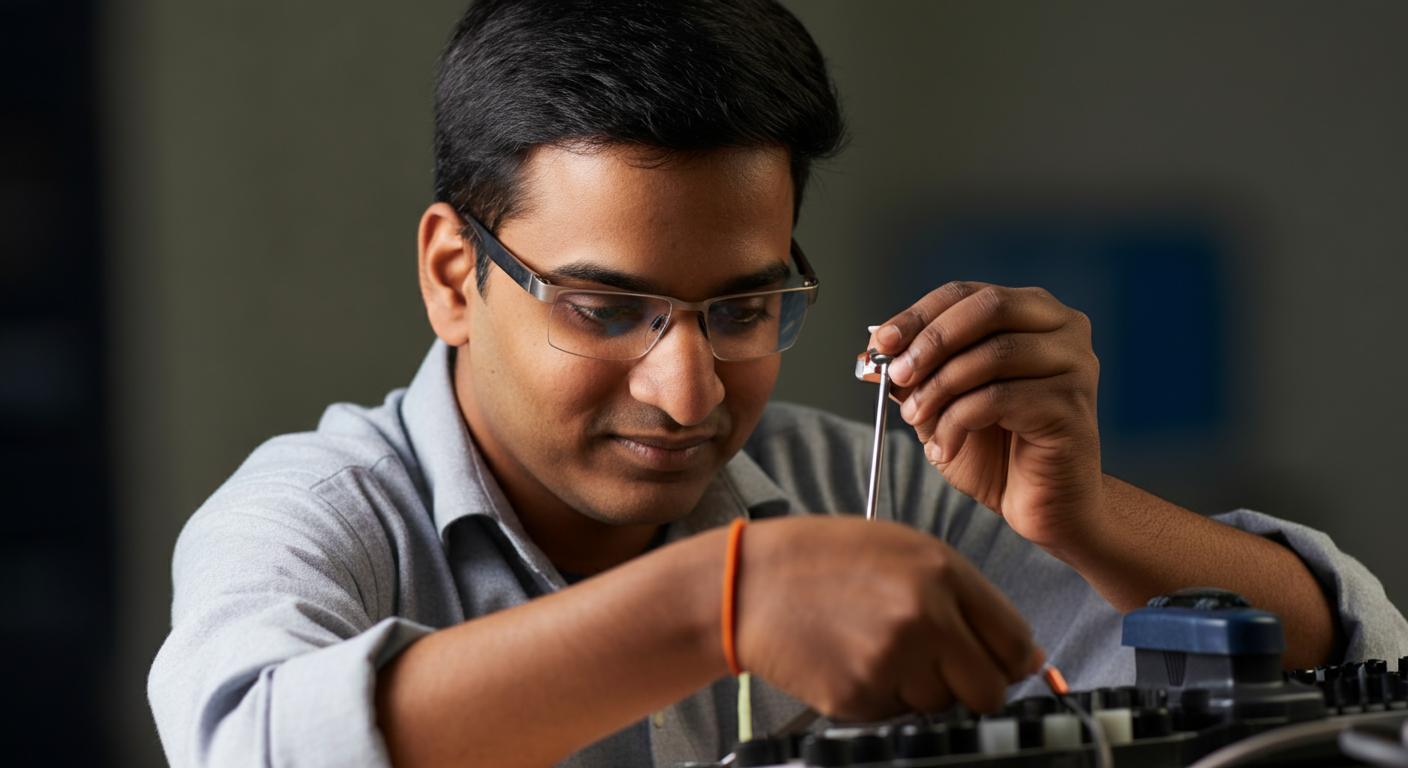
From Assembly Line to Team Lead: How Ravi Turned Hearing Loss Into a Listening Superpower
When Ravi Kumar walked onto the factory floor at a Pune auto-components plant in 2014, his supervisor handed him ear protection and pointed him to his station. What the supervisor did not know — and what Ravi never felt the need to announce — was that Ravi had been profoundly deaf since birth. He did not need ear protection. What he needed was a chance. Deaf professional career success in India is not a headline reserved for inspiration reels; it is a lived, daily reality for thousands of people like Ravi — and his story carries a blueprint anyone can follow.
Eight years after that first day on the assembly line, Ravi is a Team Lead overseeing 23 production technicians at the same facility. His team's defect rate is 34% below the plant average. His colleagues call him the best listener in the building — and they mean it literally.
The Ability Others Overlooked
Ravi's deafness is not a gap in his capability. It is, paradoxically, the source of one of his most bankable professional skills: hyper-visual attention. While his hearing colleagues rely on auditory cues to monitor machinery — a hiss, a rattle, a change in pitch — Ravi reads the machines through vibration, visual rhythm, and micro-movement. He spots a belt beginning to slip two minutes before it fails. He notices a technician's posture shifting in a way that signals fatigue or confusion.
"I see things other people hear," Ravi says through an interpreter during a conversation facilitated by his plant's HR team. "On the floor, seeing faster is worth more than anything else."
This is not exceptional. Research from Gallaudet University shows that deaf and hard-of-hearing individuals consistently score higher on visual processing and peripheral attention tasks than hearing counterparts. In manufacturing, logistics, quality assurance, and data work, these are not compensatory abilities — they are competitive advantages.
How Ravi Moved from Operator to Leader: The Five Moves
1. He Documented Everything — and Made It a System
Because verbal instructions were not accessible to him by default, Ravi developed a habit of converting every verbal briefing into written SOPs. His supervisor, initially doing this as an accommodation, quickly realized that Ravi's written records were catching ambiguities that verbal briefings glossed over. Within a year, Ravi's documentation habit became the plant's standard operating procedure format — adopted by the entire line, for every worker.
The lesson: An accommodation that serves you often serves everyone. Turning your adaptive strategies into visible systems builds credibility faster than any performance metric alone.
2. He Found a Communication Ally, Then Trained the Whole Team
Ravi's first manager, Priya Nair, learned basic Indian Sign Language (ISL) — about 150 signs — over three months. She did not do this because HR mandated it. She did it because she saw Ravi's output and wanted access to his full thinking. Within two years, six members of Ravi's team had learned enough ISL to communicate directly with him without an interpreter present.
This created a team dynamic that was unusually resilient. They had built multiple communication pathways: ISL, written chat (WhatsApp on the floor was approved for Ravi's team as a workplace adjustment), and a visual signal system Ravi designed for machinery alerts. When the pandemic forced mask-wearing and disrupted lip-reading, Ravi's team was the only one that did not experience a communication breakdown.
3. He Asked for the Promotion in Writing — and Made the Case Undeniable
When Ravi was ready for a supervisory role, he submitted a written business case to plant management. Not a request — a case. It included his team's defect reduction data over 18 months, a communication plan showing how he would manage team briefings, and three senior colleagues willing to vouch for his leadership in writing. The promotion was approved within six weeks.
"I did not ask them to take a chance on me," Ravi explains. "I showed them the numbers. Numbers do not have accents. Numbers do not need to hear."
4. He Built a Hybrid Communication Protocol for Leadership
As team lead, Ravi runs daily briefings using a three-part system: a written agenda circulated on WhatsApp 30 minutes before the meeting, a visual display board at the entrance to the floor with the day's targets and safety notes, and a 10-minute sign-assisted briefing with an interpreter present twice a week for complex updates. His team reports higher clarity about expectations than any other team in the plant — a finding that showed up in the plant's internal engagement survey two years running.
5. He Made His Success Visible — and Used It to Open Doors
Ravi now mentors three other deaf professionals at the plant and two through an NGO partnership with IMAbled's NGO partner network. He visits technical institutes in Pune twice a year to speak — through an interpreter — to deaf students about manufacturing careers. He does not position himself as an exception. He positions himself as evidence of what is already true: that deaf professionals belong in leadership, and that companies which understand this gain a measurable edge.
By the numbers
A 2023 study by the National Association of the Deaf (India) found that deaf professionals who received structured workplace communication support were 2.7× more likely to reach supervisory roles within five years. Ravi's plant, after implementing his communication systems plant-wide, saw a 41% reduction in inter-shift handover errors — a direct result of the written documentation culture he introduced.
What Made Ravi's Employer Get It Right
Ravi's success is not only his own. It required an employer who was willing to see ability where habit might suggest limitation. The specific actions that made the difference at his plant are worth naming:
- A manager who learned basic ISL — not mandated, but chosen, which made it authentic
- WhatsApp approved as a workplace tool — a ₹0 accommodation that unlocked real-time communication
- Performance reviews conducted in writing — ensuring Ravi's feedback and ambitions were fully captured
- An interpreter budget — the plant allocated ₹18,000/month for a part-time ISL interpreter for complex meetings; the ROI in reduced errors paid back within the first quarter
- Promotion criteria assessed on output, not perceived communication ease — Priya Nair fought to ensure Ravi's review was based on what he produced, not how he sounded in a room
Companies looking to hire and retain specially-abled professionals will find a practical framework in IMAbled's employer resource hub. The adjustments Ravi's employer made are not expensive. They are thoughtful.
The Career Path for Deaf Professionals in India: What's Realistic Today
The honest picture in 2025 is a mix of real progress and persistent barriers. On the progress side: major Indian employers including Infosys, Wipro, and Hindustan Unilever have formal deaf-inclusion initiatives, and the RPWD Act 2016 mandates 4% reservation in government jobs. Several BPO firms in Bengaluru and Hyderabad have built ISL-fluent supervisory teams. Startups in the fintech and SaaS space, where written communication is native to the work, are increasingly blind to hearing status in hiring.
The barriers that remain are mostly informational, not structural. Many employers do not know what accommodations are available, what they cost, or what the law requires. Many deaf job seekers do not know how to present their abilities — rather than their condition — in a way that cuts through recruiter hesitation. That is precisely the gap platforms like IMAbled's job board are designed to close.
Ravi's current salary as a team lead: ₹52,000 per month, with an annual performance bonus. He is currently enrolled in a part-time operations management diploma. His next target is plant operations manager. His timeline is 2027. He is on track.
For Deaf Professionals Reading This: Your Next Three Moves
- Document your adaptive strategies as professional systems. The way you've learned to work — the checklists, the visual cues, the written records — is not a workaround. It is a skill set. Name it that way on your CV and in interviews.
- Find the employers who already understand. You do not have to educate every hiring manager from scratch. Use IMAbled's curated job listings to find companies with demonstrated inclusion records.
- Ask for your accommodation upfront — and frame it as a performance tool. "I work most effectively with written briefings and a visual alert system" is not a request for charity. It is a professional specification, like a developer asking for dual monitors.
"The world is not designed for how I communicate. So I redesigned how my workplace communicates. That is leadership." — Ravi Kumar, Team Lead, Pune Manufacturing Plant
Frequently Asked Questions
Can a deaf professional reach senior management in an Indian company?
Yes — and it is happening today. The barriers are mostly informational (employers not knowing how to accommodate) rather than structural. With the right employer and clear communication systems in place, deaf professionals regularly advance to supervisory, management, and director-level roles. Ravi's story is one example; there are hundreds more across manufacturing, IT, legal, and creative industries in India.
What workplace accommodations are deaf professionals entitled to in India?
Under the Rights of Persons with Disabilities (RPWD) Act 2016, employers are required to provide reasonable accommodation to specially-abled employees. For deaf professionals, this commonly includes ISL interpreters for meetings, written communication tools, visual alert systems, and accessible technology. The law applies to all establishments with 20 or more employees.
Which industries in India are most welcoming to deaf professionals?
Manufacturing and quality control (where visual attention is premium), IT and software development (where most communication is written), data entry and analytics, graphic design, and legal documentation are among the most accessible. BPO firms in Bengaluru, Hyderabad, and Pune have built structured deaf-inclusion pipelines. Browse current openings on IMAbled's job board.
How should a deaf professional handle communication in a job interview?
Request your preferred format (written questions, ISL interpreter, or video relay) when confirming the interview — frame it as a communication preference, not a limitation. Bring a brief written note explaining your communication setup. Most interviewers, once the mechanics are clear, focus on your answers and abilities. Proactively offering a communication plan signals organizational and self-awareness — both leadership qualities.
How can NGOs help deaf professionals find employment in India?
NGOs partnered with IMAbled's network provide skills training in ISL interpreting, employer sensitization workshops, job matching based on ability profiles, and post-placement support. They act as the bridge between deaf talent and employers who want to hire but do not know where to start. If you are a deaf professional or know one, connecting with a registered NGO is often the fastest path to a quality placement.